Showing posts with label finance. Show all posts

Sunday, January 8, 2012

Cost,Volume,Profit Analysis-Problem 1

Cost, volume, profit analysis-Problem 1


Q. A company has the following budget on orders from home market
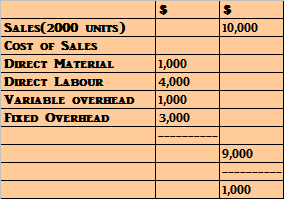


At this level of output the company has spare capacity and it is therefore planning to develop export market. It believes that it will be able to sell an additional 750 units – the limit of its production due to shortage of raw materials. No additional fixed costs would be incurred and selling price and variable costs per unit would be same as for the home market.

Before launching its export campaign, however , the company is approached by a home buyer who wishes to purchase 200 deluxe models which twice as much materials as the standard model. What is the minimum price which should be charged if this order is accepted?


Ans.  From  the data given above for 2000 units we can find the contribution per unit:-
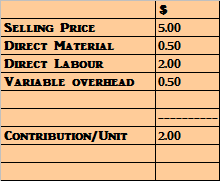


The company has spare capacity to manufacture 750 additional units which it can sell in the export.     -------------------(Given)

The contribution which the company can obtain from the sale of these 750 units
                                                                                                               = 750 * 2 = $1,500

The company’s capacity is limited by the availability of raw materials.
So the total cost of raw materials available = 2750 * .5 = $1,375

The new deluxe product which the home buyer needs requires twice the raw material.

So if the company manufactures 200 units of the deluxe product it will have spare capacity to manufacture only 350 additional units of the standard product.

Contribution from the 350 units of standard product = 350 * 2 = $700

The company can only take the order if the contribution from the 200 units of deluxe product and 350 units of standard product equals to the 750 units of the normal  product.

Contribution needed from the 200 units of deluxe product = 1500 - 350 * 2 = $800.
Contribution/unit of deluxe product = $4

The cost of the deluxe product is
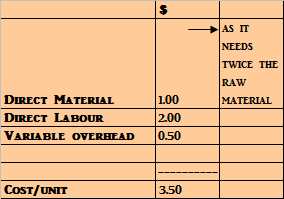


So in order to take the order for 200 units of deluxe product the company must charge a minimum price of 3.5 + 4= $7.5

Wednesday, January 4, 2012

Cost Accounting-Breakeven problem

Question

Universal Airlines is considering a proposal to initiate air service between Phoenix, Arizona and Las Vegas, Nevada. The route would be designed primarily to serve the recreation and tourist travelers that frequently travel between the two cities. By offering low-cost tourist fares, the airline hopes to persuade persons who now travel by other modes of transportation to switch and fly Universal on this route.

In addition, the airline expects to attract business travelers during the hours of 7 AM. to 6 PM. on Mondays through Fridays. The fare price schedule or tariff would be designed to charge a higher fare during business-travel hours so that tourist demand would be reduced during those hours. The company believes that a business fare of $100 one way during business hours and a fare of $60 for all other hours would result in the passenger load being equal during business-travel and tourist-travel hours.

To operate the route, the airline would need two 200-passenger jet aircraft. The aircraft would be leased at an annual cost of $10,000,000 each. Other fixed costs for ground service would amount to $ 500,000 per year. Operation of each aircraft requires a flight crew whose salaries are based primarily on the hours of flying time. The costs of the flight crew are approximately $800 per hour of flying time. Fuel costs are also a function of flying time. These costs are estimated at $1000 per hour of flying time. Flying time between Phoenix and Las Vegas is estimated at 45 minutes each way.

The costs associated with processing each passenger amount to $5. This includes ticket processing, agent commissions, and variable costs of baggage handling. Food and beverage service cost $10 per passenger and will be offered at no charge on flights during business hours. The cost of this service on non-business hour flights is expected to be recovered through charges levied for alcoholic beverages.


Required:

1 If six business flights and four tourist flights are offered each way every weekday, and twelve tourist flights are offered each way every Saturday and Sunday, what is the average number of passengers that must be carried on each flight to break even? What is the breakeven load factor or percentage of available seats occupied on a route?

2. If Universal Airlines operates the Phoenix—Las Vegas route, its aircraft on that route will be idle between midnight and 6 A.M. The airline is considering offering a “Red Die” special, which would leave Phoenix daily at midnight and return by 6 A.M. The marketing division estimates that if the fare were no more than $40, the load factor will be 50% for each “Red Die” flight. Operating costs would be at the same rate for this flight, but advertising costs of $10000 per week would be required for promotion of the service. No food or beverage costs would be borne by the company. Management wishes to know the minimum fare that would be required to break even on the “Red Die” special assuming the marketing division’s passenger estimates are correct.

Answer

Part 1.
Flying Time - Weekdays
Business - 6 flights x 2 way x 5 days x 45 minutes = 2700 minutes
Tourist - 4 flights x 2 way x 5 days x 45 minutes = 1800 minutes

Flying Time - Weekends
Tourist - 12 flights x 2 way x 2 days x 45 minutes = 2160 minutes
---------------
Total : 6660 minutes

6660 minutes/60 = 111 hours per week or 5772 hours per year (111 hours x 52 weeks)


FIXED COST
Lease : 10,000,000 x 2 flights 20,000,000
+ Ground Service : 5,000,000
Total 25,000,000

VARIABLE COST
Salaries $ 800 x 5772 hours = $4617600
Fuel Cost $ 1000 x 5772 hours = $5772000
Total : $ 10389600

Ticket Processing cost
12 flights x 5 days x 52 weeks x $5 = $15600
8 flights x 5 days x 52 weeks x $5 = $10400
24 flights x 2 days x 52 weeks x $5 = $12480
Total $38480

Food and beverages service
12 flights x 5 days x 52 weeks x $10 = $31200


SALES
12 business flights x 5 days x Y number of passengers x 52 weeks x $100 = 312000 Y
8 business flights x 5 days x Y number of passengers x 52 weeks x $60 = 124800 Y
24 business flights x 5 days x Y number of passengers x 52 weeks x $60 = 149760 Y
Total = 586560 Y

At Break Even Point
Sales = Fixed Cost + Variable Cost

586560 Y = 25000000 + 10389600 + 38480Y + 31200Y
or Y = 69 Passengers to Breakeven

Part 2
Breakeven Load Factor : 69/200 x 100 = 34.5%

Part 3
Load Factor 50% i.e. 100 passengers per flight

Time - 2 flights x 7 days x 45 minutes = 630 minutes/60 = 10.5 hours

Sales = 2 flights x 7 days x 45 minutes x $Y fare = 1400Y

1400Y = 35900 Hours

Y = 35900/1400 = $ 25.64

Tuesday, January 3, 2012

Limiting Factor - Problem 1

Limiting factor


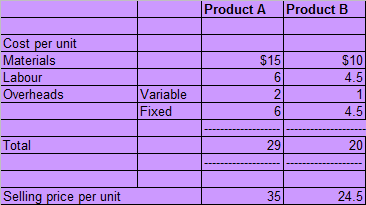
Q. In a factory producing two different kinds of articles,the limiting factor is availability of material but the same material is used in both articles:


The demand during each period for the two products is 10,000units of A and 8,000 units of B. It is also considered desirable that, should demand be there, the firm should be willing to meet at least half the demand stated above in all circumstances. The total availability of materials for sometime will be restricted to the quantity available for $120,000 only.

State how the available raw material would be utilized.


Ans. In all these problems it is necessary to understand the limiting factor and find the contribution for each product based on the limiting factor.

And then analyze any additional constraints which are given.

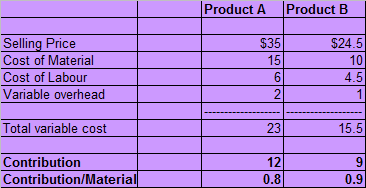
Here the limiting factor is the availability of raw materials so we need to find the contribution for each product per unit of material used which is as given below:


Its mentioned that the firm needs to meet at least half the demand for product A and product B at all times.
Demand for A = 10000
Demand for B = 8000
So the firm needs to produce at least 5000 units of Product A and 4000 units of product B.

Raw material consumed = 5000*15 + 4000*10 = $115,000

Total available raw material is worth $120,000

So the remaining 120000 – 115000 = $5000 worth of raw material should be used by the firm to manufacture the product which gives maximum contribution which is product B.

The number of units of product B that can be produced in$5000 are = 5000/10 = 500 units.

Ans. So the firm should use the raw materials such that they produce 5000 units of product A and 4500 units of product B.


Monday, January 2, 2012

Variance Analysis - Problem 2


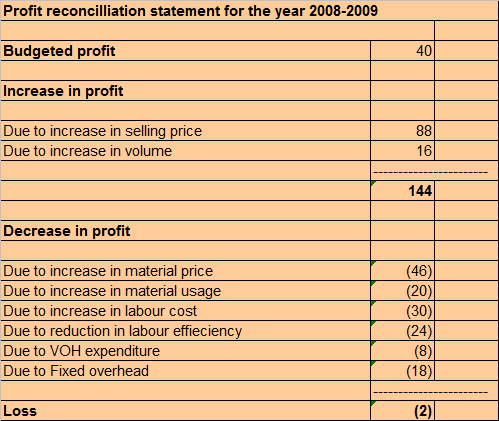
Q. A Company selling consumer durables prepared its budget for 2008-09 anticipating a profit of $ 40 Million. But the actual results for the year disclosed a net loss of $2 Million. The managing director of the company wanted to prepare a statement explaining the reasons for the loss. Details of the budget with actual are given below:-


During investigation you found that there was an overall increase of 10% in cost of material. The labourers were given 15% increase in wages as a result of agreement with trade unions. The selling prices increase by 10%. Prepare a report listing the various factors responsible for the loss of $2 mill. as against the anticipated profit of $40 mill.


Ans.
The increase in selling price = 10%(Given)

As we know that sales is a function of volume and selling price.
Sales = F(Volume,SP)
The actual volume in 2008-2009 without the increase in selling price would be = (968*100)/(100+10) = 880

The increase in SP by 10% contributes purely to increase in profit = 968 - 880 = 88 ---(I)
There is also an actual increase in volume from what was budgeted = 880 - 800 = 80 ----------(i)


Material variances

The material price increased by 10%. (Given)
The material price variance = 506 - (506*100)/(100+10) = 506 - 460 = 46 ---------------(II)

The volume increased by 80 from what was budgeted.
For a volume of 800 the material required = 400
Hence for a volume of 880 , material required would be = (880 * 400)/800 = 440
Thus the material volume variance = 440 - 400 = 40 ------------------------------------------(ii)

The difference 460 - 440 = 20 in material is due to the reduction in efficiency.
Thus the material usage variance = 20 -----------------------------------------------------------(III)


Labour Variances

The labour cost increased by 15% (Given)
The labour price variance = 230 - ((230 * 100)/(100+15)) = 230 - 200 = 30 -----------------(IV)

The volume increased by 80 from what was budgeted.
For a volume of 800 the labour cost = 160
For a volume of 880 the labour cost would be = (880*160)/800 = 176
Thus the labour cost volume variance = 176 - 160 = 16 ------------------------------------------(iii)

The difference 200 - 176 = 24 in labour is due to the reduction in efficiency.
Thus the labour efficiency variance = 24 -------------------------------------------------------------(V)


Variable Overheads

The volume increased by 80 from what was budgeted.
For a volume of 800 the variable overhead = 80
For a volume of 880 the variable overheads would be = (880*80)/800 = 88
Thus the variable overhead volume variance = 88 - 80 = 8 --------------------------------------(iv)

The difference 96 - 88 = 8 in variable overhead is the expenditure variance.
The the variable overhead expenditure variance = 8 -----------------------------------------------(VI)

Fixed Overheads

The fixed overhead variance = 138 - 120 = 18 ------------------------------------------------------(VII)

The increase in volume contributes positively to profit but it also leads to increase in material, labour and variable overhead costs.

Thus from (i), (ii), (iii) & (iv) we see that the increase in profit due to increase in volume is
= 80 – 40 – 16 – 8 = 16


Variance Analysis - Problem 1

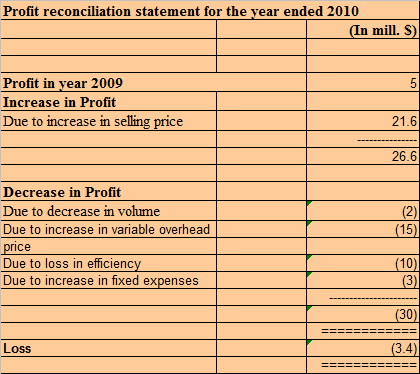
Q. A company finds that it has incurred loss during the year 2010 to the extent of $3.40 million as against a profit of $5 Million in 2009, despite increase inselling price of its sole product to the extent of 20%.

The adverse situation is mainly attributable to the increase invariable costs and fixed costs, the increase over the previous years being onaverage 15% to 20% respectively. The following figures are extracted from the books of the company:


You are requested to analyse the variances relating to sales,fixed and variable overheads over the year in order to bring out thereason for the fall in profit.


Ans.

The increase in selling price = 20% ( Given )

Sales volume in 2010 = 129.6 (mill. $ )
Sales volume in 2009 = 120 (mill. $ )

Sales volume is a function of volume and selling price.
Sales volume = F(volume,selling price)

The sales volume in 2010 without increase in selling price would be = (129.6 * 100)/(100 + 20) = 108
Thus there is an actual reduction in sales volume from 2009 to 2010 = 120 - 108 = 12 ---------- (i)

The increase of 20% in selling price contributes purely to profit = 129.6 - 108 = 21.6 -----> (I)

Variable cost in 2009 for sales volume of 120 = 100
Variable cost in 2010 for sales volume of 108 = (108 * 100)/ 120 = 90 ----------- (ii)
The variable cost volume variance = 100 - 90 = 10 -------------------------------- (iii)

The increase in variable costs in 2010 = 15% (Given)
The variable costs without the increase of 15% =(115*100)/(100+15) = 100 ----- (iv)
The increase of $ 15 mill. due to increase of 15% in variable costs is the variable cost price variance.

Variable cost price variance = 115 - 100 = 15 (mill. $) ------------------------------------> (II)

From (ii) and (iv) we observe there is a difference of 10 (mill $)in the variable costs which is due to loss in efficiency and which contributes adversely to profit.
Thus Variable cost efficiency variance = 10 (mill. $) --------------------------------------> (III)

Also the reduction in sales volume would contribute adversely to profit, however as it also leads to decrease in material usage it would affect profit only to the extent of
12 – 10 = 2 (mill. $) (From (i) & (iii) ) ---------------------------------------------->(IV)

There has been an increase in fixed costs from 2009 - 2010 for an amount of 3 (mill. $) . This would again affect profit in an adverse manner.

The Fixed overhead expenditure variance = 18 -15 = 3------------------------------> (V)


Friday, December 30, 2011

Variance Analysis-A classic case

A study of COST CONTROL and VARIANCE ANALYSIS
  • Pete Potter was known for the high quality & distinctive custom features of its ceramic bathroom fixtures.

  • His company had grown from a two-man operation to the present group of 20 master potters located in 2 large warehouses.

  • By 1980, Pete felt the need for a systematic COST-CONTROL as his business had expanded substantially. With increase in business, Peterson realized the need for better cost control and control over production scheduling, thereby adopting a STANDARD COST system.
  • Pete, with his Cost Accountant, calculated Standard cost of a toilet at $55.00 with Budgeted Volume of 1200 ceramic toilets per month.

STANDARD COST PER UNIT OF A TOILET

Material Cost

Input

unit

cost/lb

Cost/Unit

Raw Clay

25

lb

0.95

23.75

Glazing Mix

5

lb

0.75

3.75

Direct Labour Cost

Input

Unit

cost/hr


Molding

1

hr

15

15.00

Glazing

0.5

hr

15

7.50

Manufacturing OH


Variable

1


1.94

1.94

Fixed

1


3.06

3.06

COST / UNIT


55.00


ANALYSIS OF OPERATIONS

  • After 6 months of operations with new Cost system, Pete felt Standards were not met.
  • He observed that the potters were too set in their ways to adopt & follow new system properly & there was resistance to change.
  • Production for June was only 1145 toilets i.e. a shortage of 55 units from the Budgeted Volume.

ACTUAL COSTS FOR 1145 UNITS


Actual Vol.

Actual Vol.

Actual

Actual Material

Materials

Purchased

Used

Cost/lb

Cost of units used

Raw Clay

30000 lb

28900 lb

$ 0.92

26588

Glazing Mix

6000 lb

5900 lb

$ 0.78

4602

Direct Labour Cost


Actual Hours

Cost/hr

Total Labour Cost

Molding


1200 hrs

15.25

18300

Glazing


600 hrs

15.00

9000

Manufacturing OH


Units


Total OH Cost

Variable


1145


2300

Fixed


1145


3800

  • Pete met with his Master Potter, Jason, to discuss the variances and accused him of not meeting the standards.
  • The Master Potter, who was never impressed with the new system, advised Pete to ask the Cost Accountant for an explanation on Variances.
  • We will try to study the Price and Efficiency Variances in this case.


SUMMARY OF COSTS

MATERIAL COST


Raw Clay

Output

Input

Total lb

Price

Total Cost

Budget

1200

25

30000

0.95

28500

Actual

1145

25.24

28900

0.92

26588

Flexible

1145

25

28625

0.95

27194

Glazing Mix

Output

Input

Total lb

Price

Total Cost

Budget

1200

5

6000

0.75

4500

Actual

1145

5.15

5900

0.78

4602

Flexible

1145

5

5725

0.75

4294

DIRECT LABOR COST


Molding

Output

Input

Total Hrs

Price

Total Cost

Budget

1200

1

1200

15

18000

Actual

1145

1.05

1200

15.25

18300

Flexible

1145

1

1145

15

17175

Glazing

Output

Input

Total Hrs

Price

Total Cost

Budget

1200

0.5

600

15

9000

Actual

1145

0.52

600

15

9000

Flexible

1145

0.5

573

15

8588


VARIABLE OVERHEADS


VOH

Output

Rate

Total

Budget

1200

1.94

2328

Actual

1145

2.01

2300

Flexible

1145

1.94

2221

FIXED OVERHEADS


FOH

Output


Total

Budget

1200


3672

Actual

1145


3800


VARIANCE ANALYSIS


BUDGET

ACTUAL

FLEXIBLE

Vol. Var.

Price Var.

Eff. Var. /


(Budget-Flexible)


Usage Var.

Material Cost

(1)

(2)

(3)

(1) – (3)


Raw Clay

28500

26588

27194

1306 (F)

867 (F)

261 (U)

Glazing Mix

4500

4602

4294

206 (F)

177 (U)

131 (U)


Direct Labour Cost


Molding

18000

18300

17175

825 (F)

300 (U)

825 (U)

Glazing

9000

9000

8588

412 (F)

0

412 (U)


Manufacturing Overheads


Variable

2328

2300

2221

107 (F)

80 (U)

0

Fixed

3672

3800

3672

0

128 (U)

0

F – FAVOURABLE

U – UNFAVOURABLE / ADVERSE


PRICE VARIANCE

Costs

Budgeted

Actual

Cost

Actual

Price


cost

Cost

Diff.

units

Variance

Raw Clay

0.95

0.92

0.03

28900

867 F

Glazing Mix

0.75

0.78

-0.03

5900

177 U


Molding

15

15.25

-0.25

1200

300 U

Glazing

15

15

0

600

0


Manufacturing VOH

1.94

2.00873

.06793

1145

79 U


EFFICIENCY VARIANCE

Costs

Flexible

Actual

Vol

Budgeted

Efficiency


input Vol

input Vol

difference

unit price

Variance

Raw Clay

28625

28900

-275

0.95

261 U

Glazing Mix

5725

5900

-175

0.75

131 U


Molding

1145

1200

-55

15

825 U

Glazing

572.5

600

-28

15

413 U


FIXED OVERHEAD VARIANCE

COST

Budgeted

Cost

Actual Cost

Fixed OH Variance

FIXED OH

3672

3800

79 U

CONCLUSIONS

  • In his quest for reducing costs and increasing profits, Pete had used a cheaper brand of raw material which resulted in lower output.
  • Though there was Favorable Price Variance of $ 867 in Raw Clay Material cost, it lead to the following Unfavourable Efficiency Variances:

Raw Clay Material - $ 261 U

Glazing Mix Material - $ 131 U

D. Labor (Molding) - $ 825 U

D. Labor (Glazing) - $ 413 U

SUGGESTIONS

  • Pete should have taken his master potter into confidence about his intentions of procuring cheaper raw material.
  • Pete needs clear focus on objectives – whether to maintain his quality or to increase sales at the cost of quality.